Eat, Play, Love #2 - The art of letting the art go

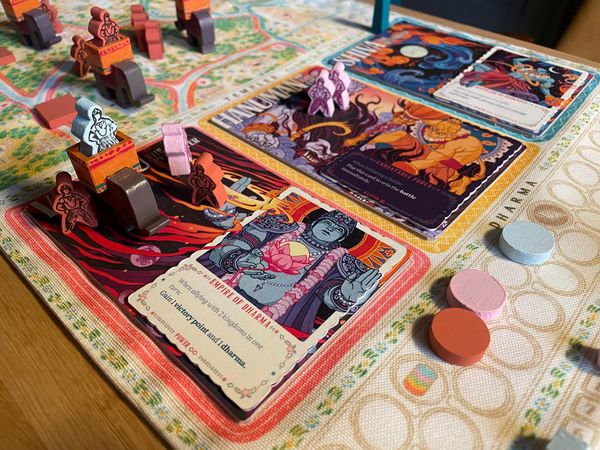
Hey! Robert here, co-designer and art director of Bharat: Kings of Legend. As many of you were commenting about the art in the game, I thought you might find the backstory interesting. From finding an artist, to seeing him going AWOL on us mid-project, and ultimately finding the best artist for the project and have the time of my life seeing it all take shape.
Having no direction at all
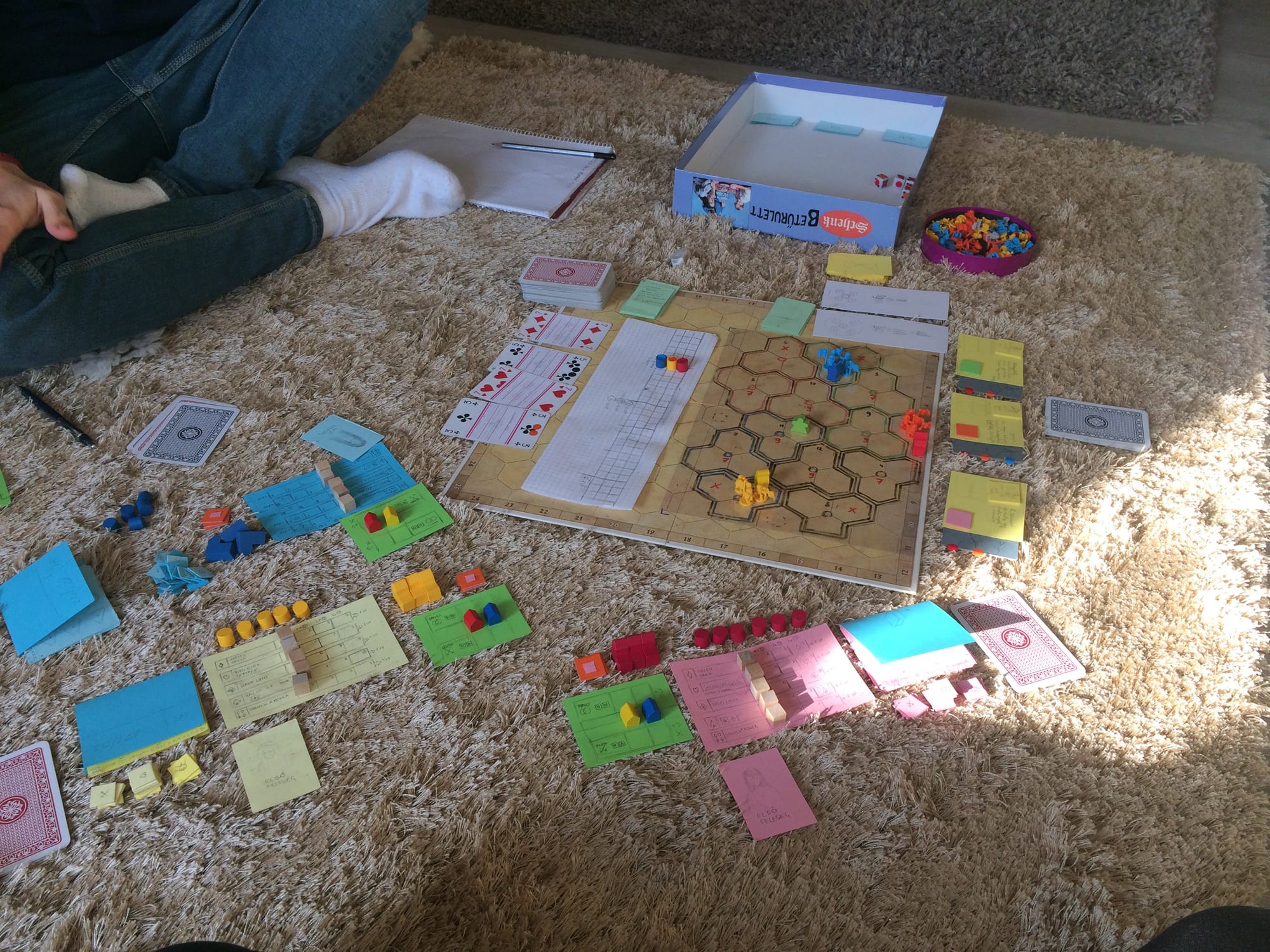
So there we were in 2018: two passionate board game noobs trying to create an epic, mythological dudes-on-a-map game. We had nothing more than a wishlist of concepts to get across, a bunch of semi-relevant games that Shut Up & Sit Down got us excited to try and learn from, and an early prototype that resembled a perfectly boring corporate workshop that had shifted gears and turned into an impromptu illegal casino. Pastel-coloured Post-it notes, spreadsheets, coins, and dice were scattered everywhere, with the only design consistency being that every single surface was covered in Sharpie markings. But we'll get to prototype evolution in a future article...
Ok, wait, here's a picture:
Years of research
As I was working full time next to this project, it was a good time in my life to dive into the visual research in my own pace. Meaning exploring hundreds of visual art rabbit holes in micro doses, one at a time. As much as it had no visible results, this helped me immensely in building the visual language of the game brick by brick, being selective in my influences and landing on a few strong foundations that would help me make the game consistent with my limited experience in illustration. Pinterest was my best friend during these times.
I had a look just now: I have 1444 saved pins across 32 boards related to the game.
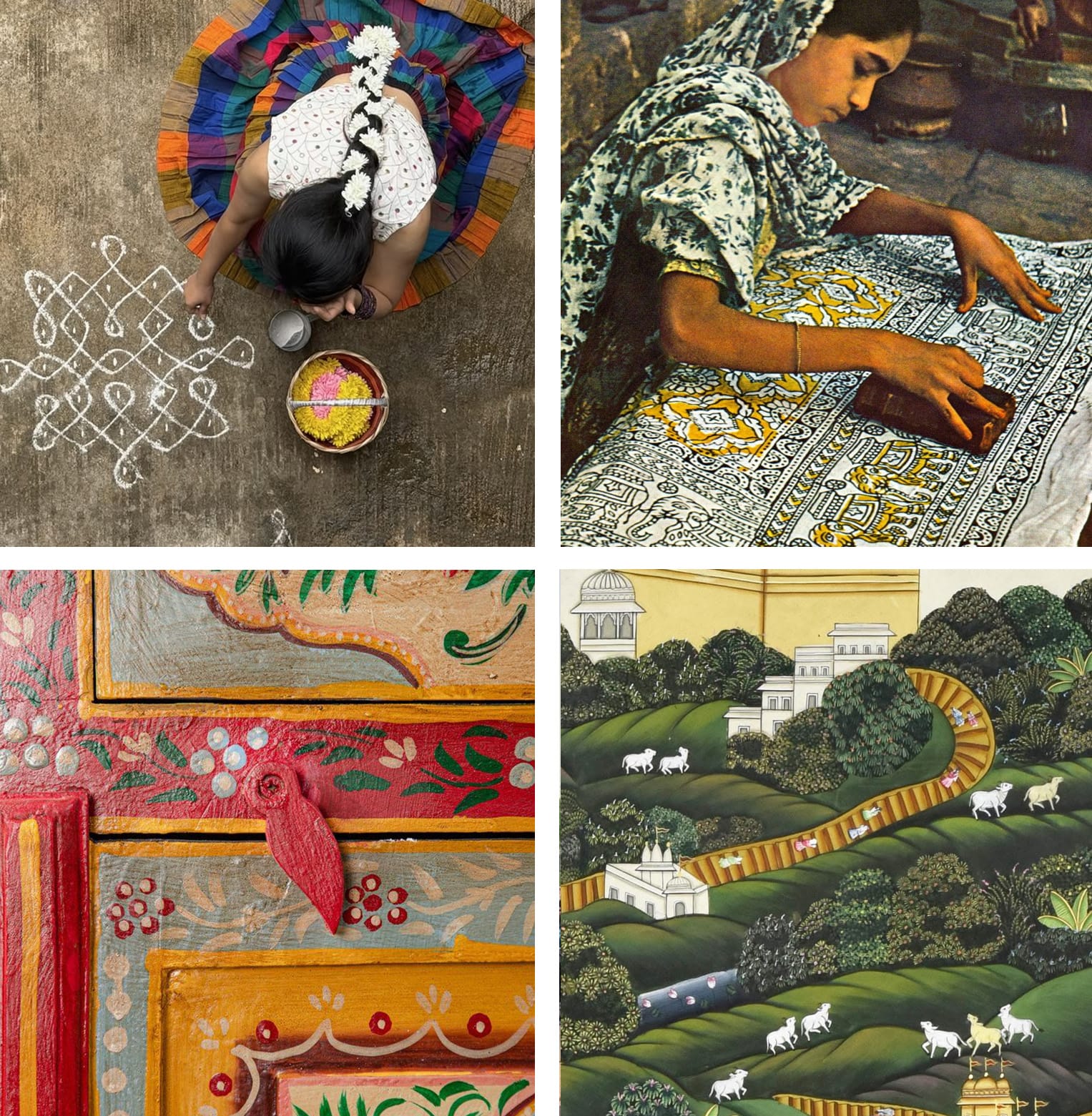
The direction I settled on was that the art should reflect traditional block printing methods, colours coming together as if 3 layers have been printed on one another, combined with the everyday ornamental elements from different regions of India. Characters and objects naively mirroring several Indian folk art traditions (like the Pichwai art tradition). Every element should follow this common thread that would glue the different parts together nicely.
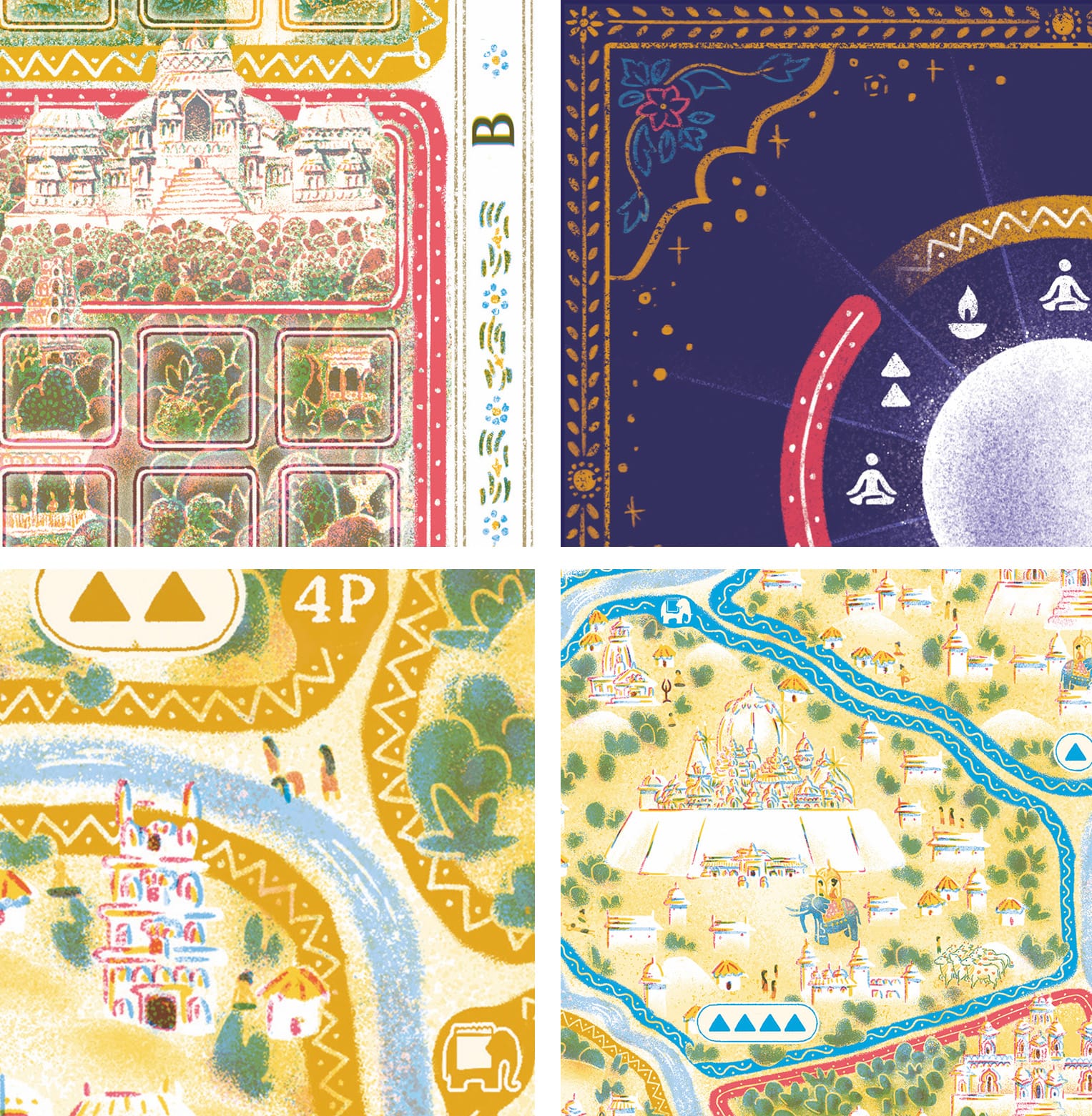
The philosophy was that the game should feel like it could be played in ancient India as it is, aiding thematic immersion as we want players to identify with their roles as kings in that specific era and culture.
It's something that few games that I really like does very well. For example, Cole Wehrle's games apply this design philosophy, I remember in a video he mentioned that Kyle Ferrin called it deco-rationalism (or something like that).
Other important design element was about the layout. The game itself, just like yoga is about the balancing of the two dualities, the Sun and Moon, the masculine and feminine qualities, the external and the internal. Sun/Moon axis is present in most parts of the design layout as well. Not just the Sun and Moon cycles where we track our actions (external action on the Sun cycle, internal on the Moon cycle), but the layout of the main board and the player board also reflects the same dual principle.
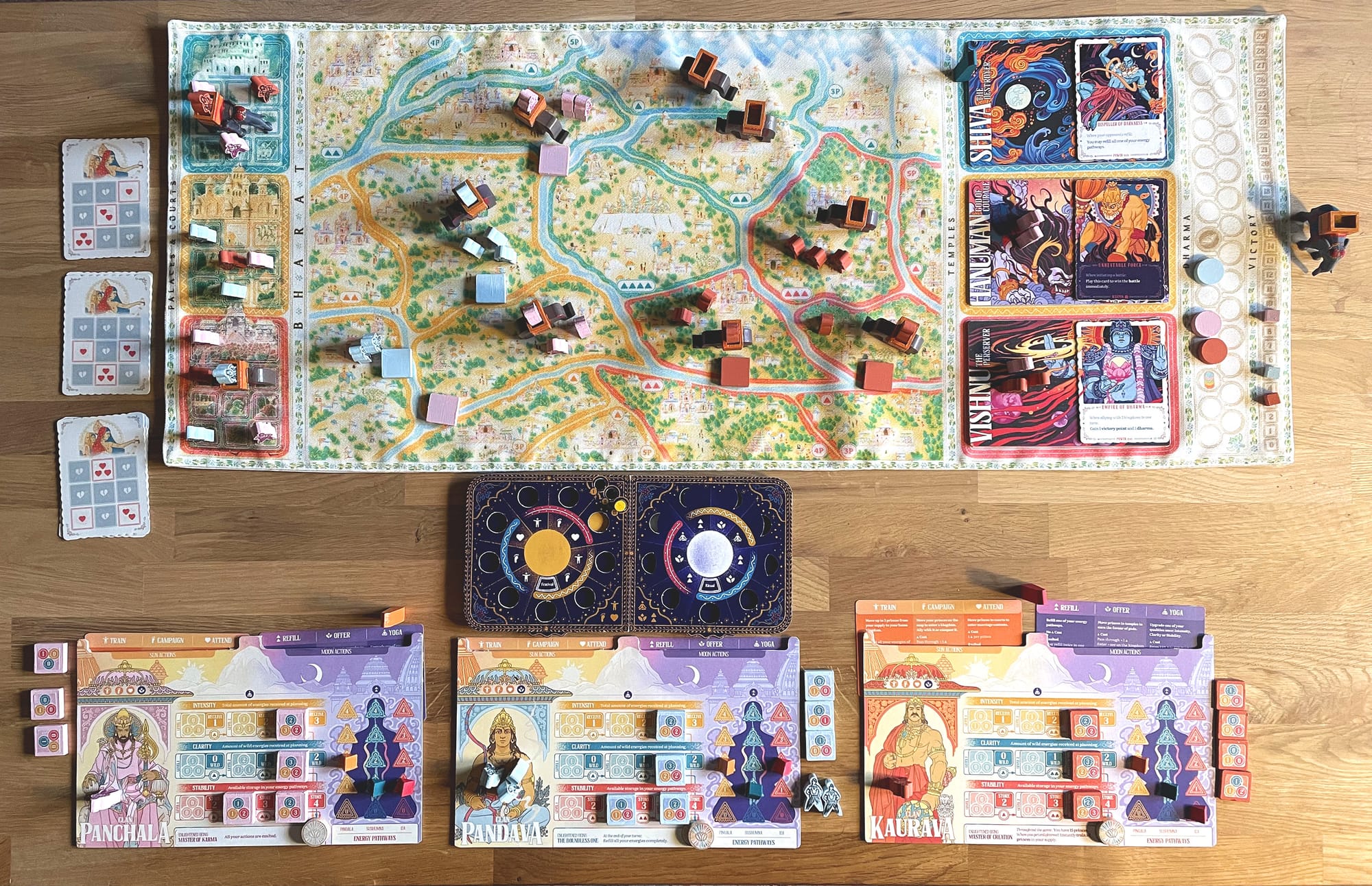
The next step was deciding what parts of the art scared me the most, and which of these were just terrifying and which were actually impossible for me to do. I decided even though the map is kinda terrifying, I can do it step-by-step. And that I'm totally unfit to take on the box art, the characters and the gods...especially the gods. Not like I couldn't force myself to do something that is kinda acceptable, but after the long research there was a blurry idea in my head about how each of these should feel like, I knew I couldn't deliver it if I had all the time in the world. So another research began.
The unbearable lightness of being an art director
At first, I thought I would find hundreds of artist who could fit the art direction the game took on. I couldn't be more wrong.
I had to realise that the subject of the art that need to be created, especially depicting gods, were just so outside the experience of most great artist I looked into. And that the only way to find an artist that could take up the work with the necessary confidence has to have experience in illustrating gods, antique environments, human characters while working in a style that is not far from the rather unusual general direction. This proved to be a massive filter.
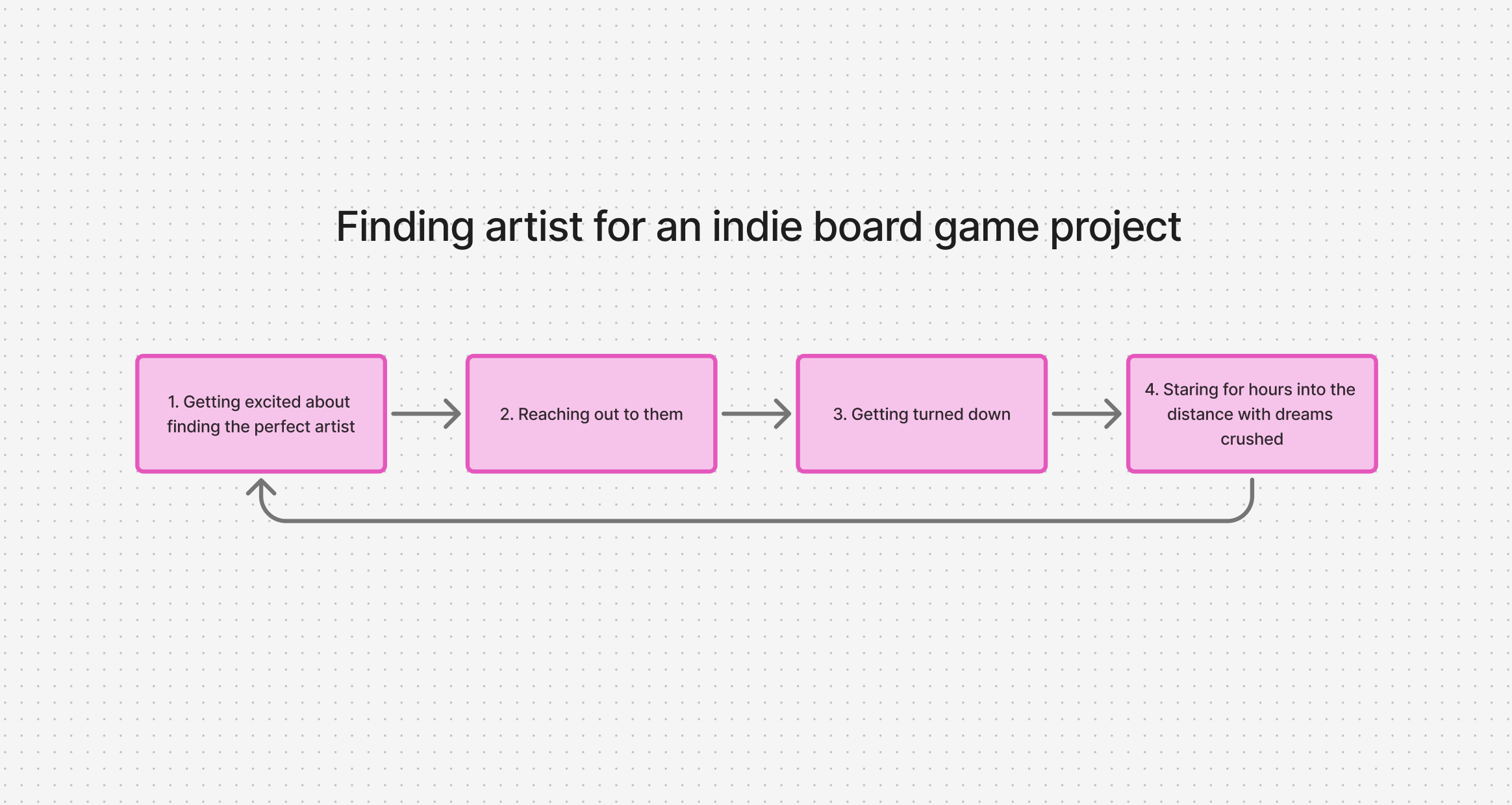
So the cycle for looking for an artist looked something like this:
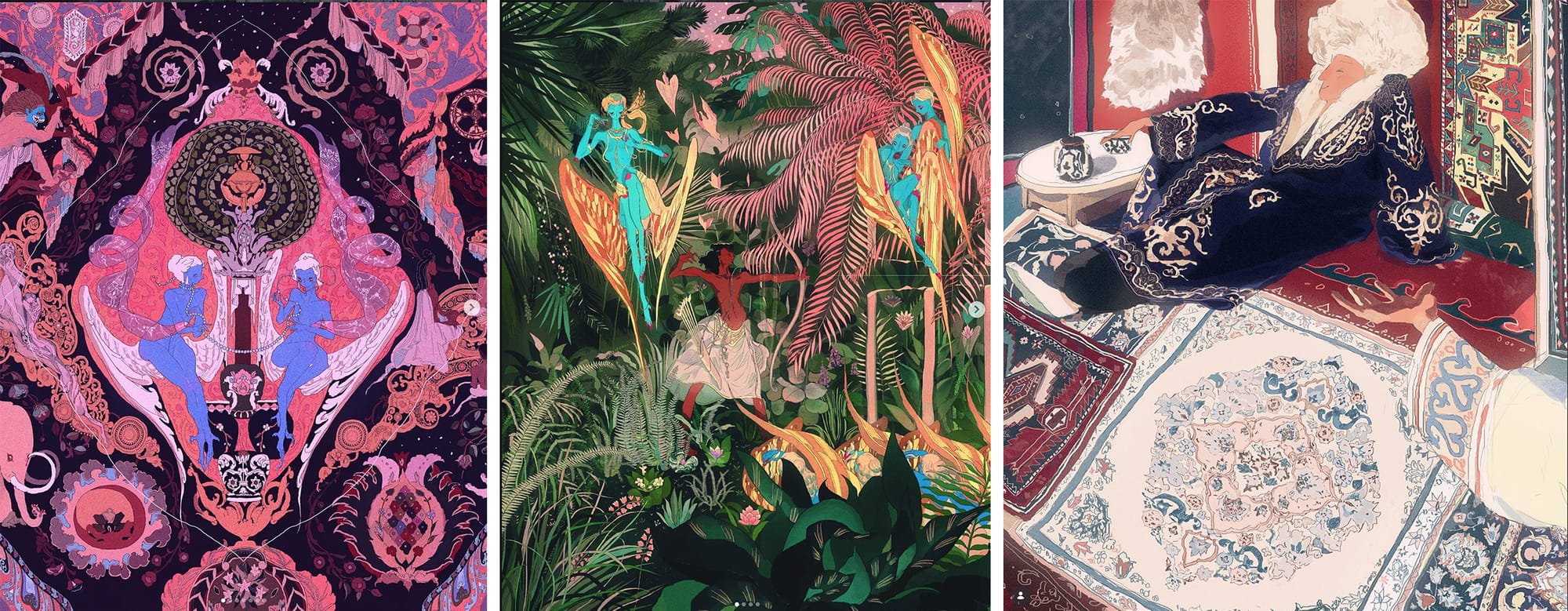
After a few memorable rides on this rollercoaster I found a wonderful artist who is actually available and excited to take on the work: Antonio Reinhard Wisesa, from Indonesia. His work is so unique and mind blowing, a unique combination of Indonesian, Buddhist and Japanese aesthetics, glued together by an otherworldy feverdream-ish quality.
The one that got away
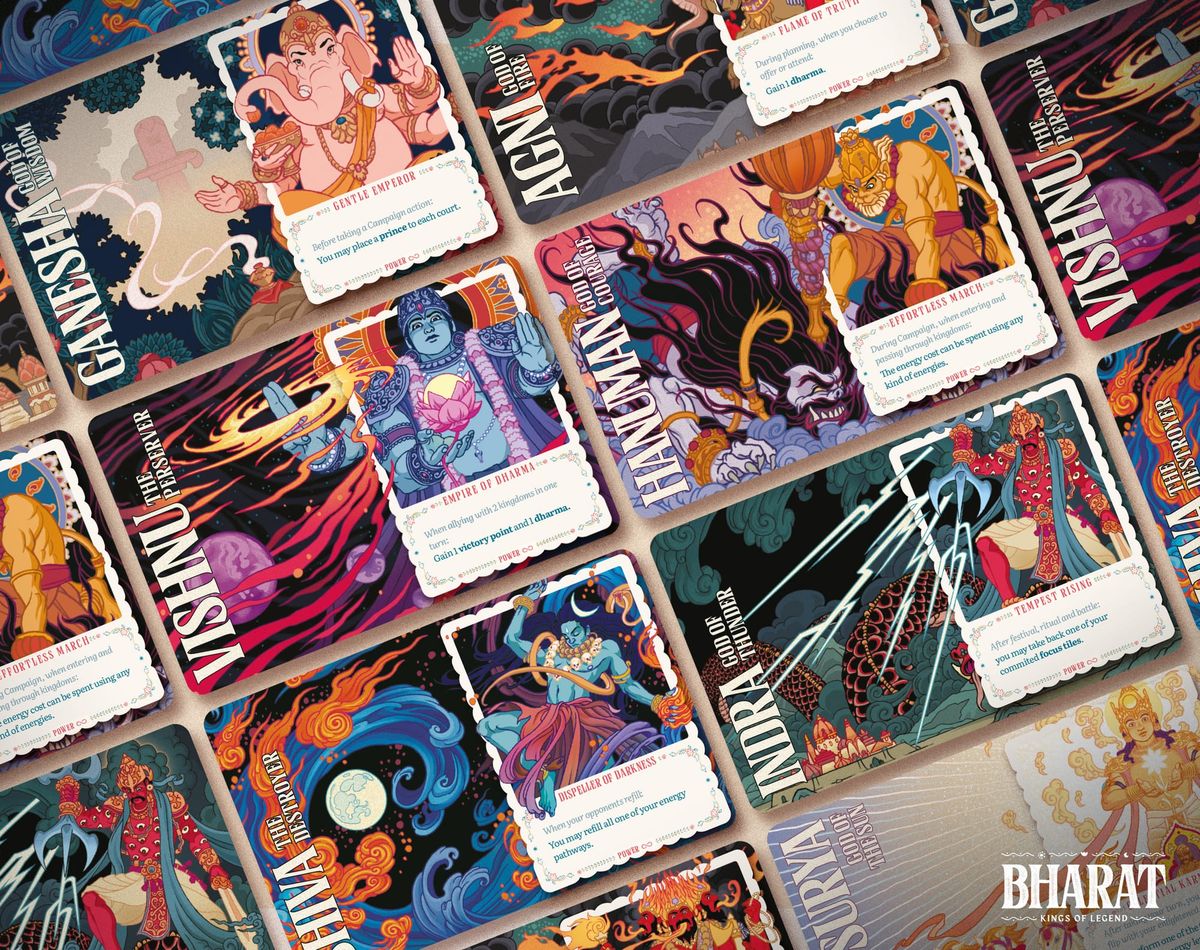
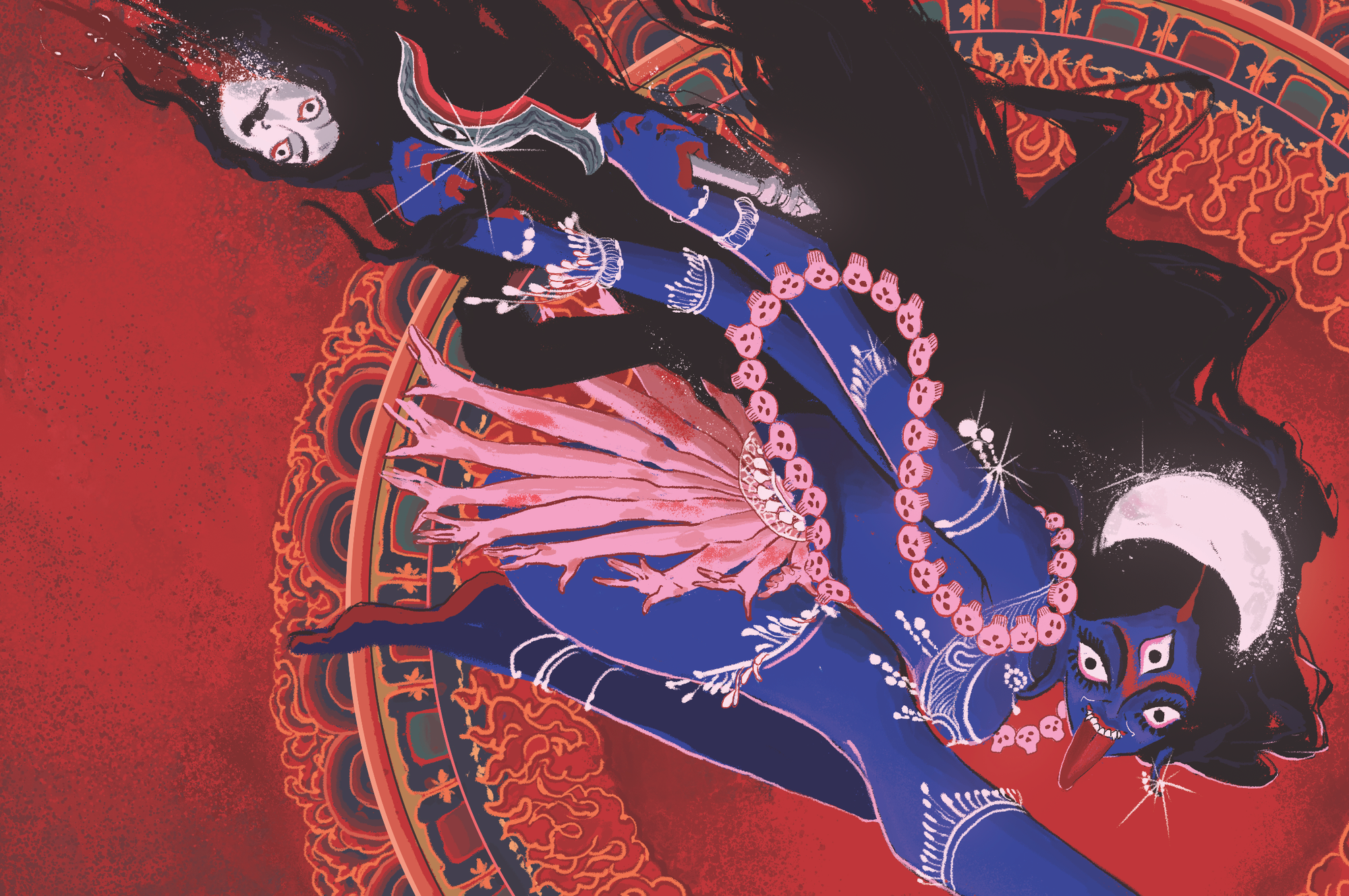
We began working on the gods first, as it was the most sensitive part, if we nail their art the rest will fall into place. This wasn't easy, as you can see his art is so intricate and rich in tiny details, it took so much time and effort for him to finish the artwork. He wanted to do it the best he could, so even though the art for the gods will only be visible in a small format (15x10cm) and we originally wanted 12 gods, he was working on a massive scale. This produced some wonderful artwork, but took much more time than he or us could possibly afford. I imagine, due to this problem, he vanished from the project after finishing 2/3 of the god artwork. We couldn't reach him ever since and never knew what happened to him - If you are reading this Toni, hope you are alive and well, and thanks for the massive effort!
So we found ourselves with no artist, part of our artist budget spent on 8 finished gods artwork, but missing some fundamental gods, that had to be in the base game...Now what?
Along with the publishing team, we came to a decision that we will be able to use the four goddesses Toni had created, outside of the base game, but we all knew that the base game could not have the art made by two different artists, given Toni's art was so idiosyncratic. So we decided to have only 7 gods in the base game which even though some of them were already done, they needed to be redone completely by another artist, and we were still missing the art for the cover and the king characters.
Our happy ending
So I instantly dived back into the artist finding loop, and after a few weeks and sleepless nights, I found Peter Diamond's art. I instantly fell in love with his work. A completely unique style heavily informed by art nouveau, mystical tales, psychedelia and the best graphic novels. His focus also fit the project perfectly: he could do gods, mystical stuff, antique environments, human characters - he just had it all.
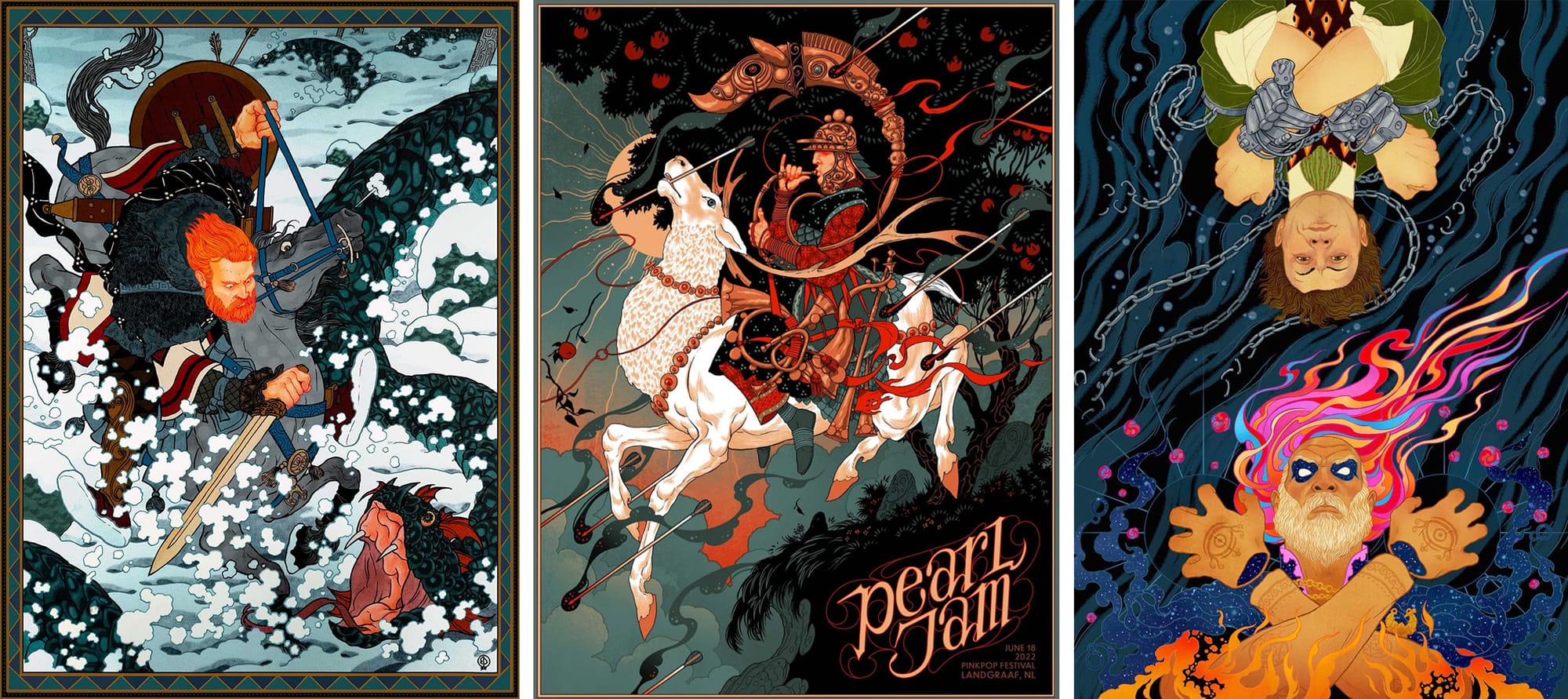
Turns out he's also a fan of Indian culture, he was excited to work together on Bharat.
He is a Canadian visual artist, based in Vienna, which was 2 hours train ride from where we based in Hungary. So Livi and I went and met him, lend him books, talk about the art, the challenges, the direction over coffee and breakfast. He struck as one of the most kind and professional artist I've ever met. His devotional attitude towards the Indian culture and his shared responsibility and sensibility to the fact that we're non-Indians attempting to capture something so important for so many people, instantly made him a third member of our team.
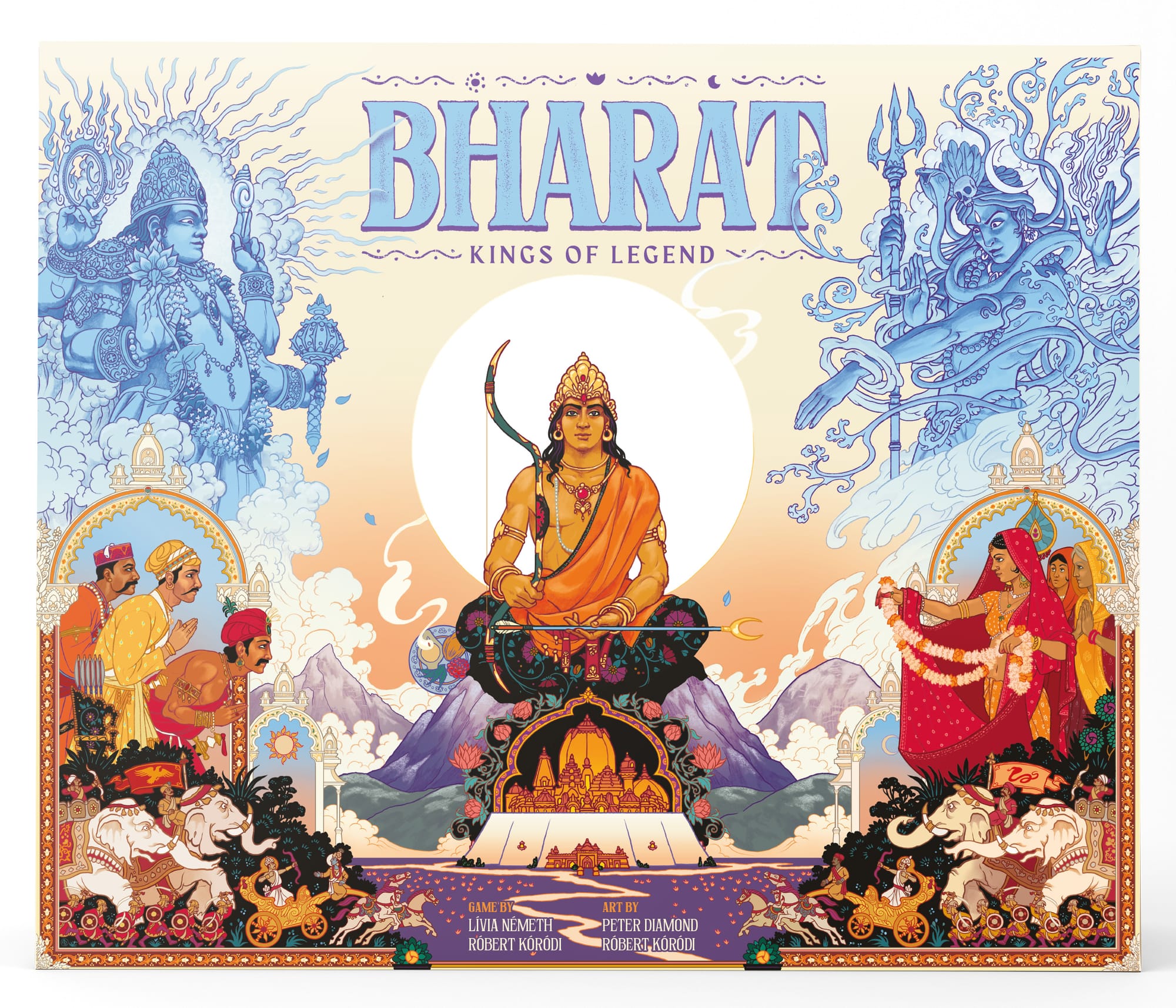
Together, both of us at our peak of inspiration we dived into the work. Exchanging the longest emails about every detail of the art. Him sharing sketches, I'm sharing moodboards, and lot of visual inspiration Livi and I came across from our time in South India, especially in the ashram and the nearby villages. Cross checking his work with the stuff I was doing for the map and the graphic design, both of us making sure it will all somehow blend together nicely. The cover art was a project in itself, where he wanted to capture every aspect of the game in a composition that is built not only for instant attention but inviting deeper exploration - reflecting the dualism of sun-moon, masculine-feminine just like the rest of the game does, while introducing a vertical axis of storytelling too.
So it was an all-consuming creative collaboration, a sort of creative pilgrimage, where all the toll the journey took, the surrender that comes with it is what actually fuels the unmatched awe you feel by the time you reach the end.
So this is how the artwork came together. To me, it was an experience I never forget, and cherish along with all its challenges and hardships, and I'm glad that the game somehow carries this whole journey in itself.